Business systems guide
Odoo implementation in Kenya business
SA
System Administrator
Super Administrator
4 views
Odoo ERP is an integrated business management system that helps Kenyan businesses manage accounting, sales, inventory, purchasing, manufacturing, payroll, and other operations from one platform. For a business in Kenya, Odoo can be configured to support local accounting requirements, KES transactions, VAT, statutory reporting, and business processes.
Odoo Implementation Guide in Kenya: A Complete Guide for Businesses
Introduction
Businesses in Kenya are increasingly adopting digital solutions to improve efficiency, reduce operational costs, and enhance financial management. As competition continues to grow across industries, organizations need reliable business management systems that can integrate their operations and provide real-time insights.
Odoo ERP is one of the leading business management solutions that enables companies to manage accounting, inventory, sales, purchasing, manufacturing, human resources, and customer relationships through a single integrated platform.
However, successful Odoo implementation requires more than installing software. Businesses must configure the system to match their operational processes, accounting requirements, and local regulatory environment.
This guide explains everything Kenyan businesses need to know about implementing Odoo ERP, from planning and configuration to data migration, training, and ongoing support.
## What Is Odoo ERP?
Odoo is an integrated Enterprise Resource Planning (ERP) system designed to help businesses manage their operations from a centralized platform.
It offers a wide range of applications that can be implemented according to the needs of a business.
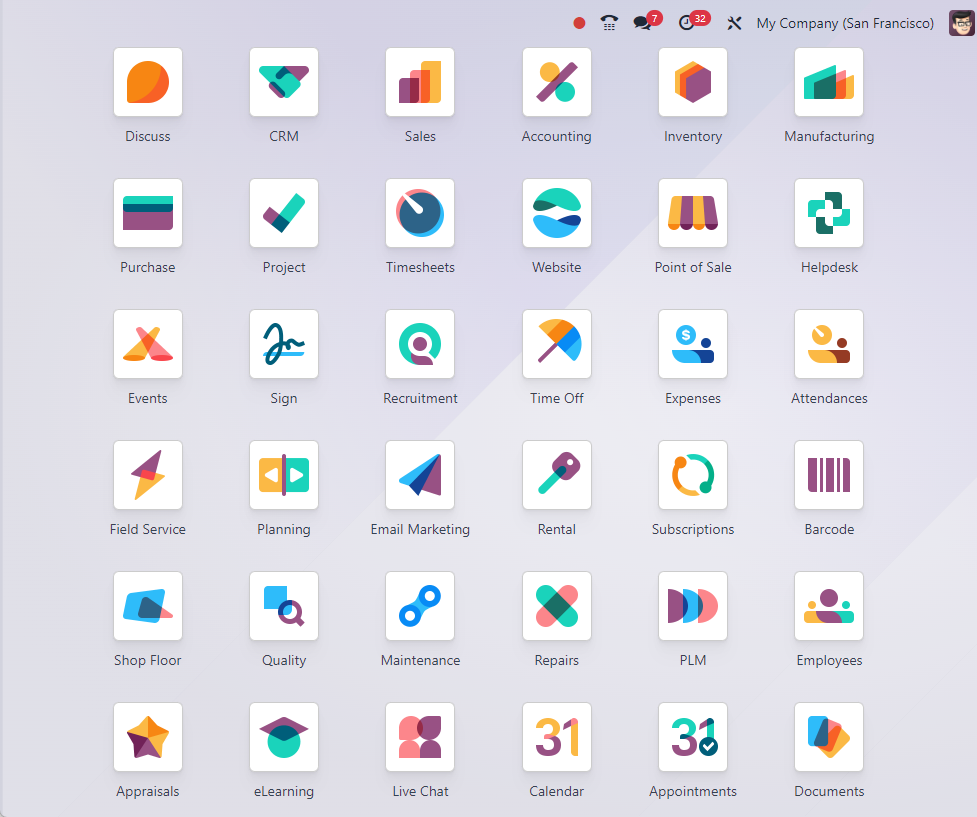
Some of the key Odoo modules include:
- Odoo Accounting
- Odoo Sales
- Odoo Inventory
- Odoo Purchase
- Odoo Manufacturing
- Odoo Point of Sale (POS)
- Odoo Human Resources
- Odoo CRM
- Odoo Website and eCommerce
- Odoo Project Management
Businesses can start with a few applications and expand their system as they grow.
## Why Kenyan Businesses Need Odoo ERP
Many businesses in Kenya still rely on spreadsheets, manual processes, and disconnected software applications to manage their operations.
These practices can lead to data duplication, inaccurate financial reports, inventory discrepancies, and delays in decision-making.
Odoo ERP addresses these challenges by integrating business processes into one system.
### 1. Integrated Accounting and Financial Management
Odoo Accounting enables businesses to manage invoices, supplier bills, customer payments, bank reconciliation, and financial reporting.
For Kenyan businesses, the accounting system can be configured to use the Kenyan Shilling (KES), applicable VAT rates, and a suitable chart of accounts.
With proper configuration, businesses can generate financial reports such as:
- Profit and Loss Statement
- Balance Sheet
- Cash Flow Statement
- Accounts Receivable
- Accounts Payable
- General Ledger
- Trial Balance
### 2. Inventory and Warehouse Management
Inventory management is essential for businesses dealing with physical products.
Odoo Inventory helps businesses monitor stock movements, manage multiple warehouses, track product quantities, and establish replenishment rules.
Features include:
- Real-time stock tracking
- Multiple warehouse management
- Barcode scanning
- Batch and lot tracking
- Expiry date management
- Stock valuation
- Reordering rules
- Inventory adjustments
This is particularly useful for supermarkets, wholesalers, distributors, pharmacies, and manufacturing companies.
### 3. Manufacturing Management
Manufacturing businesses in Kenya can use Odoo Manufacturing to manage production processes, raw materials, finished products, and production costs.
The Manufacturing module supports:
- Bills of Materials (BOM)
- Manufacturing Orders
- Work Centers
- Production Planning
- Raw Material Consumption
- Finished Goods Management
- Scrap and Waste Tracking
- Manufacturing Cost Analysis
For example, a bakery can use Odoo to manage flour, yeast, sugar, and other ingredients while tracking the production of bread, buns, pastries, and other finished products.
### 4. Sales and Customer Relationship Management
Odoo Sales and CRM help businesses manage customer relationships and sales activities.
Businesses can create quotations, convert quotations into sales orders, track customer interactions, and monitor sales performance.
The system can also integrate sales with inventory and accounting, reducing manual data entry.
### 5. Point of Sale for Retail and Hospitality
Odoo POS is suitable for retail stores, supermarkets, restaurants, cafés, and other businesses that require fast and reliable transaction processing.
Key features include:
- Fast sales processing
- Product barcode scanning
- Cash and card payment recording
- Customer management
- POS receipts
- Sales reporting
- Stock integration
- Session closing and cash control
Payment integrations such as M-PESA can be implemented where the appropriate payment provider and technical integration are available.
## Odoo Implementation Requirements in Kenya
Before implementing Odoo, businesses should identify their operational and regulatory requirements.
### Kenyan Accounting and Tax Configuration
Odoo should be configured to support the company's accounting structure and applicable tax obligations.
Important considerations include:
**Currency:** Configure the Kenyan Shilling (KES) as the company's operating currency.
**VAT:** Set up applicable VAT rates, tax accounts, and reporting requirements.
**KRA eTIMS:** Assess the business's eTIMS requirements and implement an appropriate integration where required.
**Payroll:** Configure applicable Kenyan statutory deductions, including PAYE, NSSF, SHIF, and the Affordable Housing Levy.
**Banking:** Configure bank journals, payment methods, and reconciliation processes for the company's Kenyan bank accounts.
**M-PESA:** Assess the need for Paybill, Till Number, or other mobile money integrations.
It is important to note that not all these features are automatically available in every standard Odoo installation. Some requirements may need localization modules, third-party applications, or custom development.
Businesses should verify compliance with the relevant Kenyan authorities and test all integrations before going live.
## Step-by-Step Odoo Implementation Guide in Kenya
A successful Odoo implementation should follow a structured process.
### Step 1: Business Requirements Analysis
The first step is to understand how the business operates.
The implementation team should identify the current challenges, business processes, reporting requirements, and expected outcomes.
Questions to consider include:
- How does the business currently manage accounting?
- How many warehouses or branches are involved?
- Does the business manufacture products?
- How are sales and purchases processed?
- What reports does management require?
- Which statutory requirements must be supported?
- What systems are currently being used?
The outcome should be a clear implementation plan.
### Step 2: Select the Appropriate Odoo Version
Businesses should select an Odoo version based on their functional requirements, hosting arrangements, budget, and customization needs.
Odoo offers different deployment options, including:
- Odoo Online
- Odoo.sh
- On-premise deployment
Odoo Online is suitable for businesses that need standard functionality with minimal technical customization.
Odoo.sh and on-premise deployments provide additional flexibility for businesses requiring custom modules, advanced integrations, or greater technical control.
The appropriate option depends on the organization's requirements and technical capacity.
### Step 3: Configure the Company
The company structure should be established before processing transactions.
Configuration includes:
- Company name and registration details
- Company address
- Operating currency
- Fiscal year
- Chart of accounts
- Taxes
- Bank accounts
- Accounting journals
- User accounts
- Access permissions
For businesses operating multiple branches or companies, the system should be configured to support the appropriate organizational structure.
### Step 4: Configure Business Modules
The required Odoo modules should be installed and configured according to the approved business processes.
For example, a manufacturing company may require:
- Accounting
- Inventory
- Manufacturing
- Purchase
- Sales
- Quality
- Maintenance
A retail business may require:
- Point of Sale
- Inventory
- Sales
- Purchase
- Accounting
The modules should be integrated to ensure that transactions flow correctly across departments.
### Step 5: Data Migration
Existing business records may need to be transferred from QuickBooks, Sage, Excel, or other systems.
Data migration can include:
- Customer records
- Supplier records
- Product records
- Opening stock
- Customer balances
- Supplier balances
- Bank balances
- Opening accounting balances
Before migration, data should be cleaned, reviewed, and reconciled.
Opening balances must be verified to ensure that the new Odoo system starts with accurate financial information.
### Step 6: Integrate External Systems
Many Kenyan businesses require integrations with external services.
These may include:
- KRA eTIMS
- M-PESA
- Banking platforms
- Email systems
- SMS services
- Third-party payroll applications
Integration requirements should be documented and tested before implementation is completed.
### Step 7: User Training
Employees should receive training based on their roles.
For example:
**Accountants:** Accounting entries, bank reconciliation, VAT reporting, and financial statements.
**Sales teams:** Quotations, sales orders, customer management, and invoicing.
**Warehouse teams:** Receipts, deliveries, stock transfers, and inventory adjustments.
**Production teams:** Bills of Materials, manufacturing orders, and material consumption.
**Management:** Dashboards, business reports, and performance monitoring.
Proper training helps employees adopt the system and reduces operational errors.
### Step 8: Testing and Go-Live
Before launching Odoo, the implementation team should conduct comprehensive testing.
Testing should cover:
- Sales transactions
- Purchase transactions
- Customer invoicing
- Supplier payments
- Stock movements
- Manufacturing orders
- VAT calculations
- Bank reconciliation
- Financial reports
- User permissions
Once all critical processes have been verified, the business can begin operating on Odoo.
### Step 9: Ongoing Support and Maintenance
Odoo implementation does not end at go-live.
Businesses need continuous support to resolve technical issues, improve workflows, maintain integrations, and adapt the system as operations grow.
An implementation partner should provide support, system maintenance, user assistance, and periodic reviews.
## How Much Does Odoo Implementation Cost in Kenya?
The cost of implementing Odoo in Kenya depends on the size of the business, number of users, modules required, and level of customization.
The main cost components include:
| Cost Component | Description |
| ----------------- | ------------------------------------------ |
| Odoo Subscription | Software licensing and application access |
| Implementation | Business analysis and system configuration |
| Data Migration | Transfer of existing business records |
| Customization | Development of additional functionality |
| Integration | eTIMS, M-PESA, and other external systems |
| Training | Staff training and system onboarding |
| Support | Ongoing technical assistance |
A small business implementing basic accounting and inventory may require less implementation work than a manufacturing company with multiple warehouses, production processes, and external integrations.
Businesses should request a detailed quotation based on their specific requirements.
## Common Odoo Implementation Challenges
Although Odoo offers extensive functionality, implementation can face several challenges.
### Poor Data Quality
Incomplete or inaccurate customer, supplier, product, and accounting records can affect system accuracy.
**Solution:** Clean and validate all data before migration.
### Inadequate User Training
Employees may resist the new system if they do not understand how it works.
**Solution:** Provide structured training and practical demonstrations.
### Excessive Customization
Unnecessary customization can increase costs and make future upgrades difficult.
**Solution:** Use standard Odoo functionality wherever possible.
### Poorly Defined Business Processes
Implementing a system without understanding existing processes can create operational problems.
**Solution:** Conduct a detailed business analysis before configuration.
### Inadequate Local Compliance Configuration
Incorrect VAT, payroll, or eTIMS configuration can result in reporting and compliance challenges.
**Solution:** Work with knowledgeable implementation professionals and validate the system against current Kenyan requirements.
## Why Choose Zion Systems for Odoo Implementation in Kenya?
Zion Systems provides business software solutions designed to help organizations improve efficiency, automate operations, and make better business decisions.
Our approach to Odoo implementation focuses on understanding business requirements and configuring the system to support the organization's operational needs.
Our services include:
- Odoo ERP implementation
- Odoo Accounting configuration
- Odoo Inventory management
- Odoo Manufacturing implementation
- Odoo POS implementation
- Business process automation
- Data migration
- System integration
- User training
- Technical support
We help businesses integrate their operations, improve financial visibility, and reduce reliance on manual processes.
Whether you operate a retail shop, supermarket, wholesale business, manufacturing company, restaurant, or distribution business, Zion Systems can help you explore an Odoo solution suited to your operations.
## Conclusion
Odoo ERP provides Kenyan businesses with an opportunity to integrate accounting, inventory, sales, purchasing, manufacturing, and other business processes into one platform.
However, successful implementation requires proper planning, accurate data migration, local compliance configuration, user training, and ongoing support.
By following a structured implementation process, businesses can improve operational efficiency, enhance financial control, and build a strong foundation for growth.
**Ready to implement Odoo ERP in Kenya?**
Contact Zion Systems to discuss your business requirements and discover how Odoo can help automate your operations.
Website: [https://zionsystems.co.ke/](https://zionsystems.co.ke/)
Explore our business software solutions and take the next step toward integrated business management.
## SEO recommendations for Zion Systems
Use the following SEO settings when publishing the article.
SEO TITLE
Odoo Implementation in Kenya | Complete ERP Guide – Zion Systems
META DESCRIPTION
Learn how to implement Odoo ERP in Kenya. Discover Odoo accounting, inventory, manufacturing, POS, eTIMS integration, implementation costs, and expert guidance from Zion Systems.
FOCUS KEYWORD
Odoo implementation in Kenya
URL SLUG
/odoo-implementation-kenya/
### Recommended secondary keywords
- Odoo ERP Kenya
- Odoo implementation company in Kenya
- Odoo accounting system Kenya
- Odoo ERP consultants Kenya
- Odoo manufacturing system Kenya
- Odoo POS system Kenya
- Odoo eTIMS integration Kenya
- Odoo ERP cost in Kenya
- Odoo business management system