
Odoo ERP Kenya
Complete business management software for Kenyan businesses.
odoo erp system Features
There is a point where a growing business outgrows its tools. Sales are in one system, stock in a spreadsheet, accounts with the bookkeeper, and nobody can answer a simple question — what did we actually make last month — without three people reconciling files.
Odoo replaces that with a single system where a quotation becomes a sales order, reserves the stock, generates the invoice and posts to the accounts as one connected chain. Enter something once and it is correct everywhere.
It is modular, so you start with the parts you need and add the rest as you grow. That also makes it far less disruptive to adopt than a traditional all-or-nothing ERP.
The software matters less than the implementation. Most failed ERP projects fail on process and data, not features — which is where the work below is concentrated.
Every part of Odoo, explained on its own page
Each module works on its own and shares the same data with the rest. Start where it hurts, extend when you are ready.
Odoo Accounting
Invoicing, bank reconciliation, VAT and tax reporting, fed automatically by sales and purchasing.
Learn moreOdoo Inventory
Multi-warehouse stock, reordering rules, transfers and real valuation rather than an estimate.
Learn moreOdoo POS
A till that keeps selling offline, deducts stock as it sells and reconciles at the end of the shift.
Learn moreOdoo CRM
Pipeline, quotations and orders, with a full history against every customer instead of scattered inboxes.
Learn moreOdoo Payroll & HR
Employee records, leave, attendance and payroll aligned to local statutory requirements.
Learn moreOdoo Manufacturing
Bills of materials, work orders and production costing for businesses that assemble or make what they sell.
Odoo Website & E-commerce
An online storefront that shares the same product catalogue and stock as the shop floor.
Odoo Implementation
Scoping, configuration, data migration, training and go-live support — staged, with sign-off at each point.
Learn moreOdoo Customisation
Bespoke modules, reports and integrations, written to survive the next upgrade.
Learn moreA method that survives contact with your business
Five stages, each with something you can see and sign off.
1. Scoping
We map how you work now, and where it breaks. Nothing is configured until that is agreed in writing.
2. Configuration
The system is set up around your actual processes — not the demo data, and not a generic template.
3. Data migration
Customers, products, suppliers and opening balances moved across and reconciled before go-live.
4. Training
Role-based sessions so each person learns their own job in the system, not a tour of everything.
5. Go-live & support
We are present for the first live period, when the real questions surface, and stay on afterwards.
What businesses ask us first
A focused rollout — sales, stock and invoicing for a single company — is typically a few weeks. Multi-company, manufacturing or heavy data migration takes longer. We give you a staged timeline at scoping rather than a single optimistic date.
It depends on which features you need, not on which is cheaper. We will tell you plainly if Community covers your requirements, and exactly which features would require Enterprise licensing.
Yes. Odoo can be hosted on your premises, on a cloud server, or on Odoo's own hosting. We will lay out the cost, control and maintenance trade-offs and let you choose.
Customers, suppliers, products, stock levels and opening balances are all migratable, whether they currently live in QuickBooks, Sage, Excel or another system. Data cleaning is normally the longest part — worth doing properly.
Odoo is customisable, but customisation adds cost and complicates upgrades. We prefer to configure first, and only build something bespoke where the process is genuinely a competitive advantage rather than just a habit.
You get a support agreement with defined response times, plus help with new modules, extra users and version upgrades as you grow.
Book a working demonstration
We will show you Odoo handling a process you actually recognise from your own business, and answer the awkward questions honestly.

Software Development
We design and build software that fits the way your organisation operates, rather than forcing your processes to bend around off-the-shelf products. From internal management systems and customer portals to reporting dashboards and integrations between existing tools, our development team works closely with your staff to deliver software that people actually want to use.
Learn more
Network Solutions
Reliable network infrastructure and security.
Learn more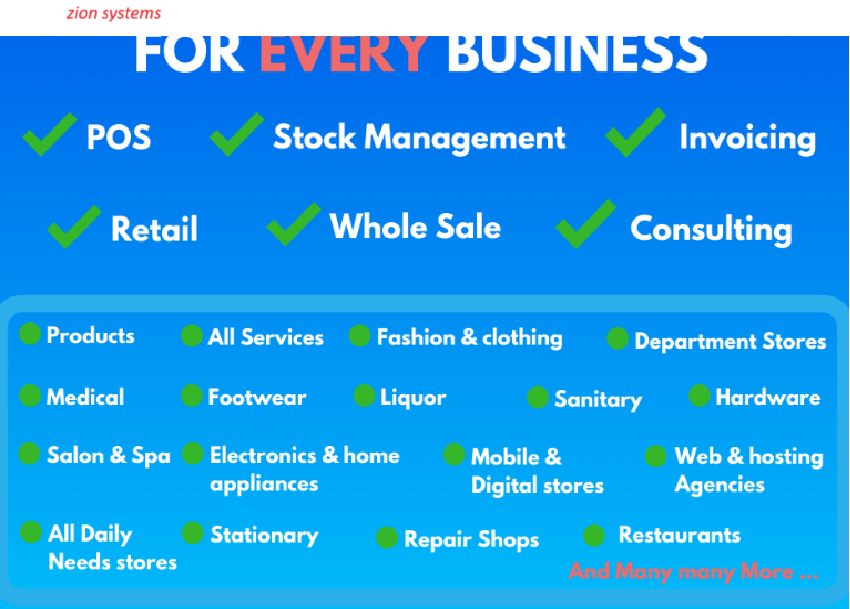
Retail Point Of Sale System
Retail Point of Sale System Complete Retail POS Solution for Smarter Business Management Zion Systems Retail Point of Sale (POS) System is a comprehensive business management solution designed to help retail businesses manage sales, inventory, purchases, customers, suppliers and finances from one easy-to-use system. Whether you operate a supermarket, minimart, boutique, electronics shop, hardware store, pharmacy or other retail business, our POS solution helps you improve accuracy, reduce
Learn more
QuickBooks Setup & Implementation Services for Businesses
Professional QuickBooks Solutions for Your Business We provide professional QuickBooks services to help businesses manage their accounting, financial records and reporting more efficiently. We help businesses set up, optimize and maintain their accounting systems while ensuring that financial information is properly organized and accessible. Our QuickBooks Services QuickBooks Setup We configure QuickBooks according to your business struct
Learn more
Odoo ERP Specialists
Odoo is a business management software suite developed in Belgium. It provides applications for customer relationship management, e-commerce, accounting, manufacturing, warehouse management, project management, and inventory management.
Learn more
Accounting systems
An Accounting Management System (AMS) is a software system used by a business to record, organize, process, and report financial transactions. It replaces manual bookkeeping and helps management know the financial position of the business at any time.
Learn more