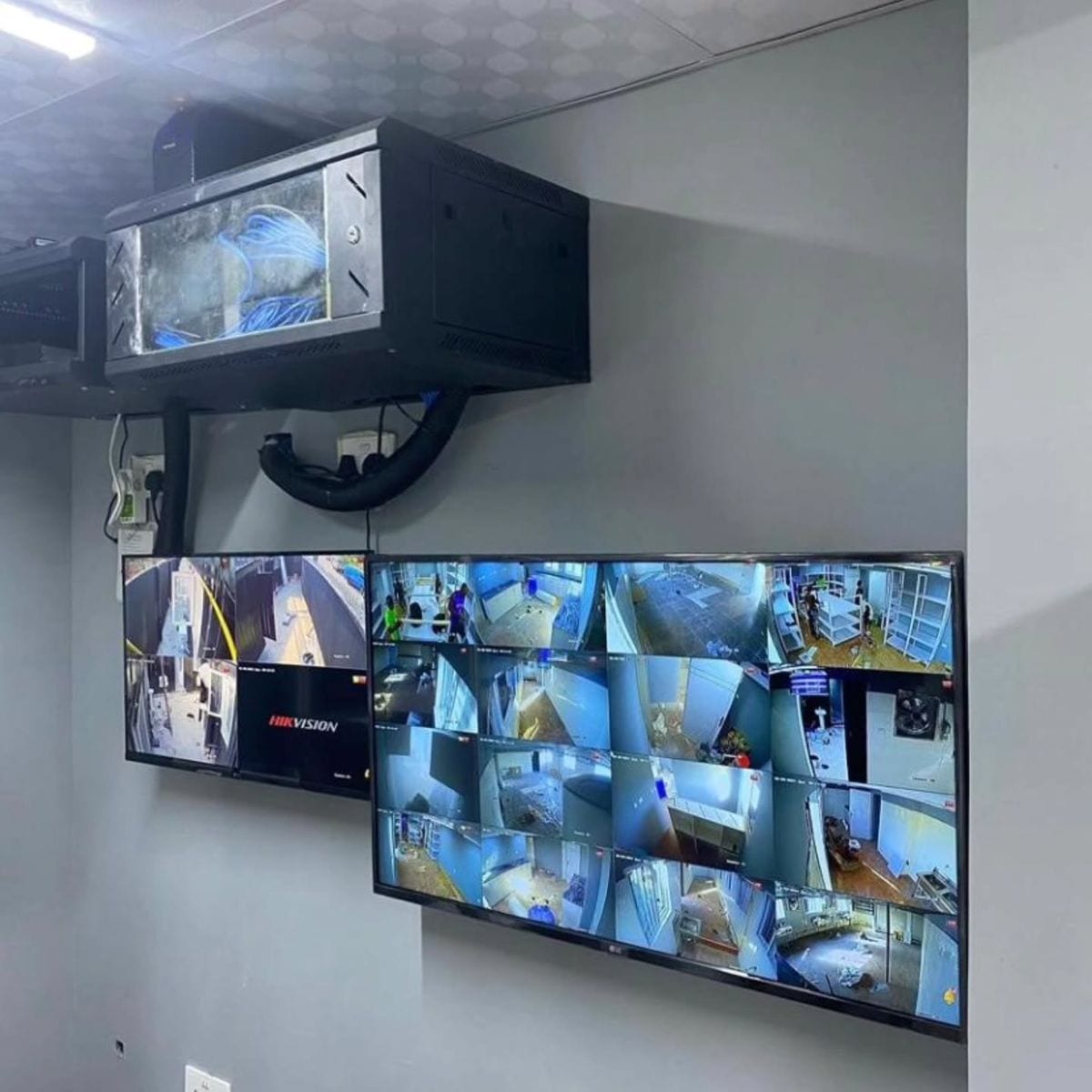
CCTV Installation and Implementation Guide in Kenya: A Complete Guide for Businesses and Homes
5 views
Below is a professional, friendly article for Zion Systems, covering CCTV implementation in Kenya, camera selection, installation, networking, security monitoring, costs, maintenance, and the importance of professional installation. The article is suitable for publication on your website to attract customers searching for CCTV installation and security system solutions in Kenya.
What Is CCTV Implementation?
CCTV implementation is the process of designing, installing, configuring, testing, and maintaining a Closed-Circuit Television (CCTV) surveillance system to enhance security and monitor activities within a property.
In Kenya, CCTV systems are increasingly used in homes, offices, schools, hospitals, retail shops, warehouses, factories, hotels, and residential apartments.
A properly implemented CCTV system helps businesses prevent theft, monitor operations, protect employees, and improve overall security.
CCTV implementation involves selecting suitable cameras, planning camera locations, installing the necessary cabling, configuring recording devices, setting up remote access, and ensuring that the system operates reliably.
For businesses seeking professional CCTV installation in Kenya, proper planning and technical implementation are essential for achieving effective security coverage.
## Why CCTV Systems Are Important in Kenya
Security is an important consideration for businesses and property owners across Kenya. CCTV surveillance provides an additional layer of protection by allowing users to monitor activities and review recorded footage when necessary.
### 1. Crime Prevention and Theft Detection
Visible CCTV cameras can discourage unauthorized access, theft, vandalism, and other security incidents.
Businesses can monitor entrances, exits, storage areas, and other critical locations to improve security.
### 2. Real-Time Security Monitoring
Modern CCTV systems allow authorized users to monitor their premises through computers, smartphones, and dedicated monitoring screens.
This is particularly useful for business owners managing multiple branches or properties.
### 3. Evidence Collection
Recorded footage can assist in investigating security incidents, identifying suspicious activities, and providing relevant evidence to authorized investigators.
### 4. Employee and Operational Monitoring
Businesses can use CCTV to monitor operational activities, improve workplace safety, and investigate incidents involving company property.
CCTV monitoring should be conducted responsibly and in accordance with applicable privacy and data protection requirements.
### 5. Protection of Residential Properties
Homeowners can install CCTV cameras to monitor gates, driveways, entrances, garages, and other appropriate areas around their properties.
Remote viewing enables homeowners to check their premises even when they are away.
## Types of CCTV Cameras Used in Kenya
Choosing the correct camera is one of the most important parts of CCTV implementation.
Different cameras serve different purposes depending on the installation environment, required image quality, lighting conditions, and coverage area.
### IP CCTV Cameras
IP cameras transmit video over an Internet Protocol network.
They are suitable for modern CCTV installations because they support high-resolution video, network connectivity, and flexible integration with other security systems.
IP CCTV cameras are commonly used in offices, commercial buildings, warehouses, and residential properties.
### Analog CCTV Cameras
Analog cameras transmit video through traditional CCTV cabling to a Digital Video Recorder (DVR).
They can be suitable for smaller installations or upgrading existing analog CCTV systems.
### Dome Cameras
Dome cameras are commonly installed indoors in locations such as:
- Offices
- Reception areas
- Retail shops
- Hotels
- Corridors
- Residential common areas
Their design makes it difficult to determine the exact direction in which the camera is pointing.
### Bullet Cameras
Bullet cameras are commonly used for outdoor surveillance.
They are suitable for monitoring gates, parking areas, building perimeters, entrances, and other outdoor locations.
Outdoor cameras should have suitable weather protection for the installation environment.
### PTZ Cameras
Pan-Tilt-Zoom cameras allow operators to remotely adjust the camera's direction and zoom.
They are suitable for large premises that require flexible monitoring, such as industrial facilities, large parking areas, and commercial compounds.
## Step-by-Step CCTV Implementation Guide in Kenya
A professional CCTV installation should follow a systematic process to ensure reliable performance and effective surveillance coverage.
### Step 1: Conduct a Security Assessment
The first step is to assess the property and identify the security requirements.
The assessment should consider:
- Property size and layout
- Number of entrances and exits
- High-risk areas
- Lighting conditions
- Existing network infrastructure
- Power availability
- Required recording duration
- Remote monitoring requirements
The security assessment helps determine the number of cameras, their locations, and the appropriate recording equipment.
### Step 2: Prepare a CCTV Camera Layout
A CCTV layout identifies where cameras will be installed and the areas each camera will monitor.
The layout should minimize blind spots and ensure that important areas receive adequate coverage.
Common CCTV camera locations include:
- Main entrances and exits
- Reception areas
- Parking spaces
- Warehouses
- Loading bays
- Corridors
- Perimeter boundaries
- Cash handling areas
Camera placement should be planned carefully to avoid unnecessary surveillance of private spaces or neighboring properties.
### Step 3: Select the Appropriate CCTV Equipment
After completing the site assessment, the next step is selecting the appropriate equipment.
A typical CCTV installation may include:
| Equipment | Purpose |
|---|---|
| CCTV Cameras | Capture video footage |
| DVR or NVR | Record and manage video |
| Hard Disk Drive | Store recorded footage |
| PoE Switch | Supply power and network connectivity to IP cameras |
| CAT6 Cable | Transmit network data |
| Monitor | Display live and recorded footage |
| UPS | Provide backup power |
| Router | Enable network connectivity and remote access |
| Camera Mounts | Secure cameras in suitable positions |
The equipment should be selected according to the project's requirements, budget, and expected performance.
### Step 4: Install CCTV Cameras and Cabling
The installation team should mount the cameras at the approved locations and install the required cabling.
For IP CCTV systems, CAT6 Ethernet cables are commonly used.
Where Power over Ethernet (PoE) is supported, a single Ethernet cable can provide both network connectivity and power to the camera.
Cable installation should be neat, secure, and protected against physical damage.
Outdoor installations should use suitable weather-resistant equipment and cable protection.
### Step 5: Configure the Recording System
The DVR or NVR should be configured to record and manage video footage.
Configuration includes:
- Adding CCTV cameras
- Setting the correct date and time
- Configuring video resolution
- Setting recording schedules
- Enabling motion detection where required
- Configuring storage
- Setting user accounts
- Configuring recording retention
The recording system should be tested to ensure that all cameras are recording correctly.
### Step 6: Configure Remote CCTV Monitoring
Remote monitoring allows authorized users to view CCTV footage from different locations.
Depending on the equipment and configuration, users may access the system through a mobile application, desktop software, or secure web interface.
Remote access configuration may include:
- Network configuration
- Secure remote access
- User authentication
- Mobile application setup
- Remote playback
- Camera viewing permissions
For security, default passwords should be changed, firmware should be updated, and unnecessary external network exposure should be avoided.
### Step 7: Configure CCTV Storage
CCTV storage determines how long recorded footage remains available for review.
Storage requirements depend on:
- Number of cameras
- Video resolution
- Frame rate
- Compression format
- Recording schedule
- Motion activity
- Required retention period
For example, a system recording continuously from multiple high-resolution cameras will require more storage than a system recording only when motion is detected.
The storage capacity should be calculated according to the actual recording requirements.
### Step 8: Test and Commission the CCTV System
Before handing over the installation, the system should be thoroughly tested.
Testing should include:
- Camera image quality
- Day and night performance
- Camera coverage
- Recording functionality
- Playback functionality
- Remote access
- Motion detection
- Storage performance
- Power backup
- Network connectivity
The installation team should confirm that all cameras operate correctly and that the customer understands how to use the system.
### Step 9: Provide Documentation and User Training
A professional CCTV implementation should include documentation and user training.
The handover may include:
- Camera location layout
- Equipment details
- Network configuration information
- User access instructions
- Recording and playback guide
- Maintenance recommendations
- Warranty information
Users should also be trained on how to review footage, manage authorized access, and respond to system alerts.
## CCTV Implementation Requirements in Kenya
Businesses implementing CCTV systems in Kenya should consider privacy, data protection, and the responsible management of recorded footage.
### Kenya Data Protection Act, 2019
CCTV footage may contain personal data when individuals can be identified.
Organizations operating CCTV systems should consider their obligations under the Data Protection Act, 2019, and applicable regulations.
Relevant requirements may include:
- Establishing a lawful purpose for surveillance
- Informing individuals that CCTV monitoring is taking place
- Limiting camera coverage to appropriate areas
- Restricting access to recorded footage
- Protecting footage against unauthorized access
- Establishing appropriate retention periods
- Handling requests concerning personal data appropriately
The Office of the Data Protection Commissioner (ODPC) provides guidance on data protection requirements in Kenya.
Organizations should assess whether they are required to register as data controllers or processors, including where CCTV is used for security-related purposes.
Source: [Office of the Data Protection Commissioner – Data Protection Laws Kenya](https://www.odpc.go.ke/data-protection-laws-kenya/)
### CCTV Installation and Private Security Regulation
Businesses providing private security services, including certain CCTV installation, maintenance, and monitoring services, should assess the applicable requirements under Kenya's Private Security Regulation Act.
The Private Security Regulatory Authority (PSRA) provides information on the regulation of private security services in Kenya.
Source: [Private Security Regulatory Authority](https://www.psra.go.ke/psr-act-2016/)
## How Much Does CCTV Installation Cost in Kenya?
CCTV installation costs vary depending on the equipment, number of cameras, installation complexity, and system requirements.
The main cost components include:
| Cost Component | Description |
|---|---|
| CCTV Cameras | Camera type, resolution, and features |
| DVR/NVR | Recording and management equipment |
| Storage | Hard disk capacity |
| Cabling | CAT6, coaxial cable, and accessories |
| Installation | Labour and mounting |
| Networking | Switches, routers, and configuration |
| Power Backup | UPS and backup power equipment |
| Maintenance | Servicing and technical support |
A small residential installation will generally require less equipment and labour than a large commercial CCTV project.
For an accurate quotation, a site assessment should be conducted to determine the number of cameras, cable lengths, storage requirements, and installation complexity.
## Common CCTV Implementation Challenges
### Poor Camera Placement
Incorrect camera positioning can create blind spots and reduce the effectiveness of surveillance.
**Solution:** Conduct a site survey and prepare a camera layout before installation.
### Unreliable Power Supply
Power interruptions can affect CCTV recording and monitoring.
**Solution:** Use suitable backup power equipment, such as a UPS, and assess the backup requirements of the entire system.
### Insufficient Storage
Inadequate storage capacity may result in footage being overwritten before it is needed.
**Solution:** Calculate storage requirements based on the number of cameras, recording settings, and retention period.
### Weak Network Security
Poorly secured CCTV devices can expose surveillance systems to unauthorized access.
**Solution:** Use strong passwords, update firmware, restrict access, and configure secure remote connectivity.
### Poor Image Quality at Night
Inadequate lighting or unsuitable camera selection can reduce image quality after dark.
**Solution:** Select cameras with appropriate low-light capabilities and infrared illumination, and assess lighting conditions during installation planning.
## Why Choose Zion Systems for CCTV Installation in Kenya?
Zion Systems provides ICT and security solutions designed to help businesses and property owners improve security, automate operations, and protect their assets.
Our CCTV implementation services focus on understanding customer requirements and delivering suitable surveillance solutions.
Our services include:
- CCTV camera installation
- IP CCTV systems
- Analog CCTV systems
- CCTV networking
- Remote CCTV monitoring configuration
- CCTV maintenance and troubleshooting
- Access control integration
- Structured cabling
- Network infrastructure
- Security system upgrades
We support CCTV implementation for offices, retail shops, warehouses, schools, residential properties, commercial buildings, and other facilities.
Our approach focuses on reliable equipment, proper installation, secure configuration, and dependable technical support.
Whether you need a CCTV system for your home, business, or commercial property, Zion Systems can help you identify a suitable security solution.
## Conclusion
CCTV implementation is an important investment for businesses and property owners seeking to improve security and monitor their premises.
A successful CCTV installation requires proper planning, suitable equipment selection, professional cabling, secure configuration, adequate storage, and thorough testing.
By implementing a well-designed CCTV system, businesses can improve security visibility, protect their assets, and support better operational management.
Zion Systems provides CCTV installation and security solutions tailored to the needs of Kenyan businesses and property owners.
**Looking for professional CCTV installation in Kenya?**
Contact Zion Systems today to discuss your CCTV requirements and get a suitable security solution for your home or business.
Website: https://zionsystems.co.ke/
Explore our CCTV, networking, and security system solutions and take the next step toward a safer environment.